Monday, 15 August 2011

Print

Montessori Activity: Pasting Stickers/Påsætning af Klistermærker/贴上贴纸 (Level 1)


Age: From 2.5 years old (Level 1)

Activity Duration: 5 - 10 minutes

Objectives:
1. To train the child's motor skills.
2. To train the child's hand eye coordination.

Materials:
1. 1 sticker sheet
2. 1 note book
3. 1 tray

Directions:
1. Show the child how to remove the sticker from the sheet and paste it in a page in the note book.

2. Encourage your child to try.

Additional Information:
Joshua tried this for the first time this evening and he enjoyed it very much. He could transfer and paste the stickers into the notebook, but it wasn't so easy for him. Thus, the challenge was just right. He needed my help to remove the sticker from the sheet. The stickers I have were very small, thus it was more challenging. Using bigger stickers would be easier.

16.8.2011 Updates:
Joshua enjoyed this so much yesterday that he asked to do it again this evening. He continued on until I asked him to stop to take his shower.

15.8.2011 (2Y5M10D)

15.8.2011 (2Y5M10D)

15.8.2011 (2Y5M10D) - A page of stickers pasted by Joshua
Updates:

We had some left-overs stickers that our Little FECS has out-grown. Our Little FECS told me that Baby FECS showed interest in stickers. So we decided to let her try this activity today :-)

She could not peel and paste the stickers by herself, but she enjoyed pointing and choosing the stickers of her choice and seeing us pasting them. I think she got the concept of pasting stickers.

 9 July 2017 (Y1M23D)


Saturday, 13 August 2011

Print

Montessori Acitivity: Sweeping with Brush & Dustpan


Age: From 2.5 years old

Activity Duration: 5-10 minutes

Objectives:

1. To train fine motor skills to swipe into a designated area.
2. To teach shape.
3. To teach the concept of inside and outside of the line.

Materials:

1. 1 small brush
2. 1 small dustpan
3. 1 small container of oatmeal
4. 1 tray taped and drawn with a rectangle in the middle

Directions:

1. Pour the oatmeal on the tray randomly outside of the rectangle.
2. Show your child how to sweep the oatmeal into the middle and say "all the oatmeal is now inside the rectangle.
3. Show your child how to sweep the oatmeal inside the rectangle into the dustpan.
4. Repeat by pouring the oatmeal on the tray again and ask your child to try to sweep it into the middle.

Tips:
1. You can also tape a circle or triangle shape in the middle for variety.

Additional Information:

Before introducing the Toddler's Cleaning Kit, it is good to first let the toddler try this sweeping activity. J (2Y5M8D) can't sweep the oatmeal into the rectangle yet. He swept it all over the tray, and sometimes on the floor. But I told him that he should try to swipe within the tray. He then tried to sweep the oatmeal into the dustpan, which he did pretty well.


Tuesday, 9 August 2011

Print

Montessori Activity: Ladling


Age: From 1.5 years old

Activity Duration: 5-15 minutes

Preparation Time: 3 minutes

Objective(s): 1. To train the child’s fine motor skills.

Materials:

1. 2 buckets, one filled with water
2. 1 ladle
3. 1 tray

Directions:

1. Demonstrate to your toddler by ladling the water from the big buket to the small bucket.
2. Encourage and let your child try it.

Cost: 

Ladle 5 DKK (1.15 SGD) from Søstrene
Big Bucket (20 DKK) from Netto

Additional Information:

J asked to do Montessori after dinner during bath time. So I took out beans and let him ladle, but he didn't want it. Then I took out containers with lids, and he also didn't want it. AARRRGGGHHH!!! (I need to think of ways to make containers with lids interesting again, as I think he can do with more practice).

He (2Y5M4D) asked for activities with water. So I tried this, and it as a hit. He loves the metal buckets. There is something very cute and attractive about these buckets, that I think would attract most children.


Updates: Baby FECS' turn with Montessori :-)


8 July 2017 (1Y1M22D)


Print

Montessori Activity: Using Spray-Bottle


Age: From 2 years old

Activity Duration: 5-15 minutes

Preparation Time: 5 minutes

Objective(s):

1. To train fine motor skill.
2. To train the child’s hand-eye coordination skill.

Materials:

1. 1 spray bottle filled with water
2. 1 small bucket
3. 1 tray

Directions:

1. Demonstrate to your child how to spray water into the bucket.

2. Let your child try.

Tips:

1. While your child is at it, talk about the colour of the bucket. Talk about the water in the bucket.

Additional Information:

When J first started using the spray bottle, he had difficulty reaching the handle. Here is a simple way to isolate the activity to purely spraying using just 2 items - spray bottle and bucket.

This evening, he (2Y5M4D) tried this, and after spraying continuously for 10 minutes, he has mastered the art of spraying. Practise makes perfect, also for toddlers.

Monday, 8 August 2011

Print

Age Classification of Children

1. Infant/Baby: Age 0 - 1

2. Toddler: Age 1 - 3 (Singapore N1: Age 2 - 3)

3. Preschooler/Pre-K/Nursery: Age 3 - 5 (Singapore N2: Age 3 - 4, Singapore N3: Age 4 - 5)

4. Kindergartener: Age 5 - 7 (Singapore K1: Age 5 - 6, Singapore K2: Age 6 - 7, USA Grade 1: Age 6)

5. Children: 7 - 10 (Singapore Primary 1 - 4, USA Grade 2 - 5)

6. Pre-teen: 10 - 12 (Singapore Primary 5 - 6, USA Grade 5 - 6)

7. Teenage: 12 - 18 years old (Singapore Secondary 1 - 4, Singapore Junior College 1 - 2)

References:
http://en.wikipedia.org/wiki/Toddler

http://www.moe.gov.sg/education/preschool/
Print

Chronicles of a Babywise Mom: Activity Overload

Chronicles of a Babywise Mom: Activity Overload: "image source Here is a fact about me you might not know. I like to be busy. Okay, maybe you figured that out. But I like to run around ..."

Sunday, 7 August 2011

Print

Growth of J From Birth

I am creating this album as a summary for me to help me to remember each of J's special milestones and the memories we had each month since his birth. It is more organized for me to put it all under one roof in my blog (as I use this blog as my electronic category management, archiving and retrival filing system). It is not meant to compare with other toddlers. Every child is special. This post is thus more for myself than the general public.
  
Print

Shrimps Salad with Baby Spinach Leaves


Recipe from my colleague Fon

Serves 1

Preparation Time: 5 minutes

Ingredients:
- 1 handful of frozen shrimps
- 1 handful of baby spinach leaves or lettuce
- 1 stalk of spring onions chopped
- 1 TBS olive oil
- Dash of pepper (I usually do without it because it is not available)

Directions:
1. Wash, rinse and drain baby spinach leaves

2. Thaw the frozen shrimps in microwave oven for 2 minutes. It should come out cold, but thawed.

3. Add to the shrimps and spring onions to the baby spinach leaves.

4. Drizzle with olive oil, and sprinkle with pepper and mix well.

Additional Information:
This is a super simple, super fast, very cheap and very healthy meal. I learned this from my colleague Fon. This is what I eat for lunch at work everyday. In fact, many of my colleagues are doing the same. We have all been inspired by Fon :-) The frozen shrimps and the olive oil make it really tasty. Try it.

Nowadays Joshua is very picky about food, so I don't feel motivated making "proper" dinner. I eat this for dinner too (in fact, I am doing it now, and thought I will share the recipe).

If you wonder how I manage to have time to prepare Montessori activities for Joshua, it is because my lunch and dinner are so easy to make - 5 minutes each. And Florian? It is summer time, and he eats yogurt for breakfast and dinner.


Print

Montessori Activity: Cracking Eggs


Inspired by Hapalab

Age: From 2.5 years old

Activity Duration: 5 minutes

Materials:

1. 2 fresh eggs
2. 2 bowls, 1 for the shell and one for the egg
3. 1 tray

Directions:

1. Demonstrate to  your chid how to crack an egg, by knocking the egg against the bowl on the right, pull open the shell and put the shell on the bowl on the left.

2. Let your child try it himself with the other egg.

Video Demonstration:

Here is a video demonstration by Hapalab:
http://www.youtube.com/watch?v=fzJ-N2Xlb_c

Additional Information:

J did a great job the first time he cracked an egg two weeks ago (2Y4M15D). It could just be a coincidence that he did it so well. I then showed him the video of the boy in the video cracking the egg beautifully. Ever since then, he dare not crack an egg, and want me to do it for him. However, he asks to watch the egg cracking video every weekend, and thereafter, he would ask me to crack the egg for him, after watching the video!!! Hmmmm... sometimes it may not help to show your child video of how other children perform the task.

References:

http://hapalab.blogspot.com/2011/02/sunnyside-up.html
Print

Montessori Activity: Tracing Shapes


Age: From 3 years old (Level 4)

Activity Duration: 5 - 10 minutes

Materials:
1. 1 shape stencil
2. 1 magic pen or marker
3. 1 plain paper

Directions:
1. Demonstrate by holding the stencil on a paper and tracing a shape with a marker.

2. Let your child try.

Additional Information:
Here is another way of letting your child draw. Joshua sometimes get bored with just drawing freely on paper. A few days ago 4.8.2011, I let him (2Y4M30D) try to trace shapes. He is, of course, too young to be able to trace out any decent shape, but he tried very hard, and really enjoyed it. Today, he asked to repeat it again.

Saturday, 6 August 2011

Print

Home-Schooling Curriculum

An excellent and most comprehensive homeschooling curriculum that covers all subject areas for all ages from toddlers to 4th grader from Joyful Heart. I also love the many excellent books they are using.
Print

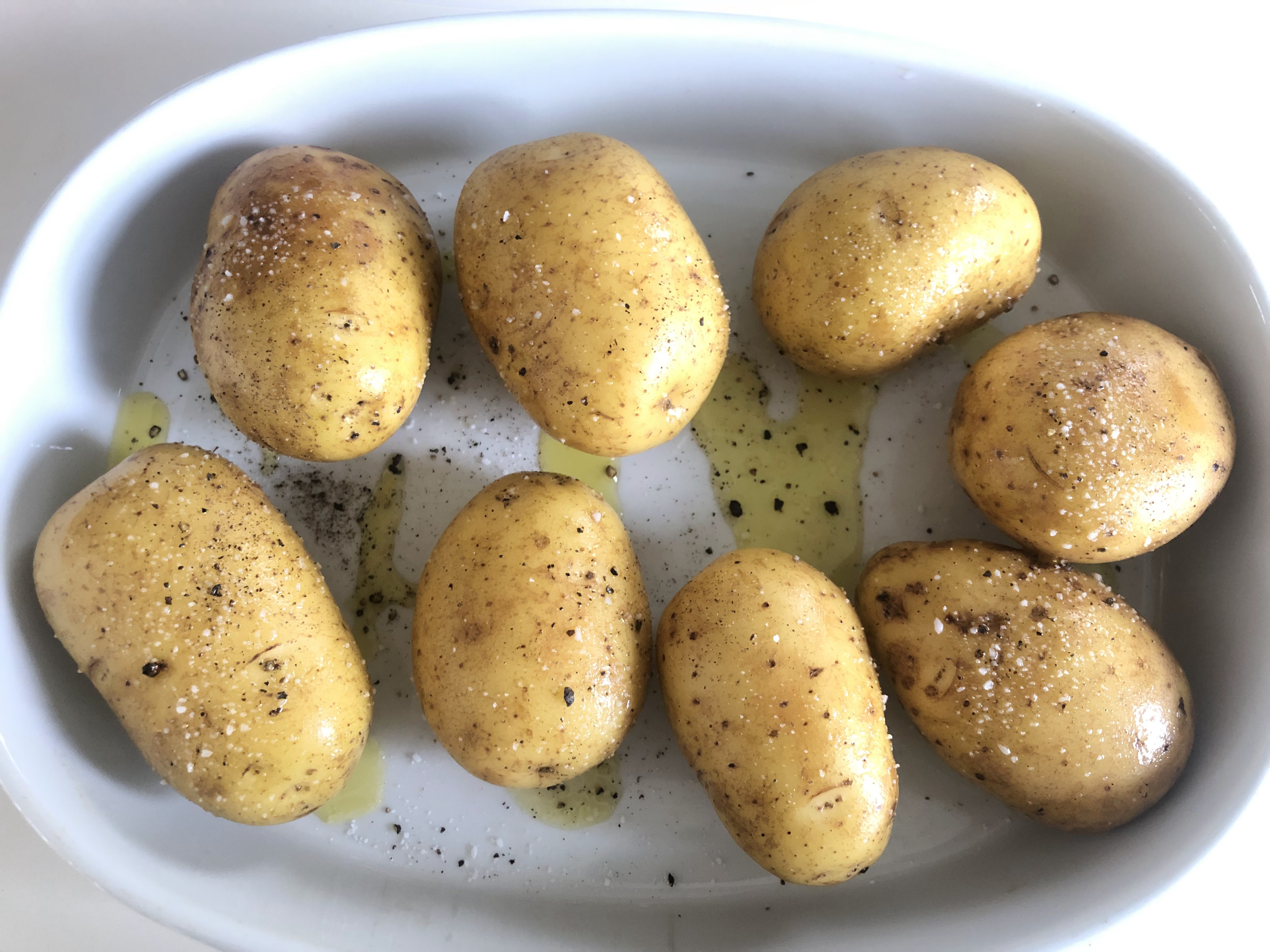
Baked Jacket Potatoes


Serves 4

Cooking & Preparation Time: 1 hour

Ingredients:
- 4 big potatoes
- 1 TBS olive oil
- 2 tsp dried herbs such as rosemary, timian, basel or oregano
- Salt & pepper

Directions:
1. Pre-heat oven to 200°C (492°F).
2. Wash and scrub potatoes clean.
3. Cut potatoes length wise and let them dry on a kitchen towel.
4. Place potatoes on an oven-proof dish.
5. Coat them with the dressing of olive oil, dried herbs, salt and pepper using a brush.
6. Bake it in the oven for 40 minutes to 1 hour until it is golden and crispy. (For whole jacket potatoes, bake for 1.5 to 2 hours.)
7. Serve on its own, or sprinkle with grated cheese, chives or tuna salad.

Tips:
You can also serve with smoked salmon, baked beans, etc. as toppings.

Additional Information:
Mr. FECS made this for dinner today, and it tasted really good. So I decided to record down the recipe. He baked it for an hour. Unfortunately, we didn't mange to take a picture.

References:
http://jari.dk/jarisopskrifter/halve_ovnbagte_kartofler.html

In an oven-proof dish, drizzle olive oil, sprinkle salt and pepper over potatoes and bake for 40 minutes to an hour at 200 degree celsius.


Print

Inexpensive Birthday Ideas: Balloon Canopy


Materials:
1. 10-15 balloons
2. Canopy from Ikea
3. Kid's size chair for the birthday child

Directions:
1. Tie the side opening of the canopy with a safety-pin.
2. Fill the canopy with balloons and tie the bottom of the canopy with a ribbon,
3. Hang the canopy with balloons on the ceiling.
4. Ask the birthday child to sit on the chair.
5. Sing the birthday song, blow candles, then take the cake away.
6. Release the canopy for the balloons to fall out.
7. Have your camera ready, watch the children have fun and laughter with the balloons :-)

Additional Information:
Amy, Joshua's childhood friend, turned 3 year old today. We tried out this brillant idea from Lori of My Montessori Moments. I can't believe that a party-pooper like me started organizing a party for a 3-year old!!! But there was no pressure, no other guests except Joshua, thus, it took a lot of pressure from me :-)

Lori has more fun and inexpensive birthday ideas. Check out her blog: http://mymontessorimoments.com/page/2/

References:
http://mymontessorimoments.com/page/2/


Friday, 5 August 2011

Print

Montessori Acitivity: Flour Sensory Box


Age: From 1.5 year old

Activity Duration: 5-10 minutes

Preparation Time: 3 minutes

Objective(s):

1. To stimulate and develop the 5 senses.
2. To introduce the opposite concept of heavy and light.

Materials:

1. 1 transparent storage box approx. 40 x 30 x 16cm
2. 1 packet of flour (2 kg)
3. 1 spoon
4. 1 cup
5. 1 bowl
6. 3 measuring cups
7. Some small animal figurines or dinasour to dig.

Directions:

1. Mix them in the box.

2. Let your child spoon, scoop, dig, pour, transfer etc. to find the toys inside.

Additional Information:

I created a dinasour excavation site with sand sometime this summer, but the Danish summer had been so eratic and quite some rain. When it was sun, we just rush out to the park and out-doors, thus, I haven't had the chance to let Joshua play with it at our Balcony.

The Danish summer is soon over... thus I make this as our month of August sensory box with flour instead. It is easier for me to allow myself to let Joshua to play with it, than sand.

This morning, I gave it to Joshua, but he didn't want AT ALL to play with it. I saw so many toddlers and preschoolers having so much fun with such sensory boxes from blogs, but well, just not Joshua. I think I have introduced this to him too late. He is past the period. Well, we all learn right :-) I will keep this box for other children or the church nursery, before emptying it.

Hmmm... I am not sure if I will still try to make another sensory box come September...

Updates 13.8.2011

I put the box out near the door, preparing to bring it to church for the Nursery Cleaning Day today, and Joshua saw it, and asked to play with it. Surprisingly, he played with it for quite a while this time round, and later he wanted to scope the flour into another container. So I took an empty sensory tub box and let him scope the flour into it. So, this sensory box has been successfully in the end.

The children at the nursery today also enjoyed it very much. But we could not contain the activity the conventional Montessori way, in that it was a BIG mess with flour all over the table and on the flour!!! Good that this happened on a clean up day, so that it was alright for the children to make as much mess as they wanted :-)

13.8.2011 (2Y5M8D) - Joshua playing with flour sensory bin

13.8.2011 - Children having fun with flour sensory bin at FIBC Nursery Cleaning Day

14.8.2011 (2Y5M9D)


Print

J Summary (2Y5M0D) - Requested to Go to Bed

J did not nap for the second time in 2 days. He was clearly tired today, when I picked him up. I was kind to him, and he managed to prevent himself from a melt down and tantrums, but I could see that he was cranky. He didn't eat much for dinner, but asked to read books. I said, you meant read books and sleep. To my surprise, he said yes. This was the first time, he told me by his own iniative that he wanted to sleep. I told him that we have to go and bath first. After bathing, for the rare time ever, he sat through patiently with 2-3 books, and then willingly accepted lights off. Then he was hungry and asked to eat a banana. The room was shut at 6.45pm. Sweet dreams.

This morning, he managed to complete the small penguin and the bird jigsaws puzzles without any help.

Thursday, 4 August 2011

Print

Thinking about Singapore...


Singapore's National Day is around the corner on 9th August, and I can't help but feel my heart aching...

Singapore has been highly successful with the casinos since its launch a year ago and they are earning Singapore tons of money... but is it money that we can feel honourable about earning? Are we so greedy for money, that it doesn't matter anymore how we make them? Are we not having enough faith that Singapore and the people living in Singapore can make a good living from good honest means?

Casinos are known to break up families and cause social problems. Singaporeans are openly discouraged by the government to visit the casinos. Singaporeans who want to enter the casinos have to pay a 100 SGD entry levy. If it is bad for Singaporeans, it would be equally bad for foreigners. Are we a nation only caring for ourselves and not others? Those foreigners who come to the Singapore's casinos also have a family behind them. For every foreign dollar we earn from the casinos, how many foreign families are we breaking up indirectly? Is that right? 

We have become a country that partake in such crime against humanity - to both foreigners and Singaporeans, when we scramble with the rest of the world to partake in the lucrative share of the casino pie, and yet it is so morally and wickedly wrong. I plead silently in my heart to our government - Let go of such money. Let the money go elsewhere... faraway from the shores of Singapore. Don't touch it. Whatever we have earned from last year, return it. It really isn't good for Singapore.

I can't agree more with Tan Jee Say on the casinos: "The two huge casinos are the wrong kind of services activities to have. Economic development is more than just about generating jobs and income growth. There is a moral purpose as well, otherwise we might as well turn Singapore into a prostitution hub or a distribution centre for drugs which will bring us untold riches. Economic development is about developing and using human capital to produce decent and worthwhile goods and services in a sustained way.

On the other hand, casinos are a soft option that preys on human weakness to generate profits. They destroy the work ethic and lead to broken families and other social problems. The casinos should be closed down so that Singapore can part company with those who choose to prosper through vices such as gambling, prostitution or drugs; only then can Singaporeans once again walk tall and proud on the high and honourable path to economic development and prosperity."

I quote from Galaviz "The financial sector in Singapore needs Singapore to be known as a stable, serious and very ethical place for doing business." The casinos are not providing that, and would only serve to lead Singapore away from the clean reputation that we have built up over the 5 decades of nation building.

Would we feel proud of our sons and daughters making their living off working in the casino industries?

No, I wouldn't.

May we have the wisdom and integrity to return back to the long and narrow path in generating economic growth through pure hard work that is truly honourable.

May we pray for wisdom for those governing our country.

Dear God, this coming National Day, I pray for forgiveness for the sins we have committed towards the foreigners, when we brought in the casinos and joined the gang in earning such unclean money. I pray for your mercy and I pray for a repentent heart, that Singapore will turn away from this sin.

Wednesday, 3 August 2011

Print

How to Organize a Playdate for Preschoolers?


Some of the playdates we had went well, but many didn't. Quite often, we talked our time away with the children running around and playing aimlessly. At the end of the day, many of us wondered what we had done to those precious time!!! Quite often, we didn't know when to leave, and only after the children became cranky, did we leave, which was way too late. It was also hard to manage the chaos, and when the children left, the place looked like a post-tsunami zone, with toys splattered all over the place. Some of the mothers didn't bother showing up for playdates anymore, while the host would think twice about hosting another playdate.... ouch!

While it is good that we are able to chill out and talk, while our children are busy playing by themselves, I think it is also important to make it educational. I want to be better at organizing playdates. I started learning from other's experiences. Here is what I have learned and looking forward to put it to practical application:

I. 4 Golden Rules:

1. Keep the Playdate Small

It is better to limit to one or two children. Three really is a crowd when it comes to toddler playdates according to Sara Wilford, director of the Early Childhood Center at Sarah Lawrence College in Bronxville, New York. With more children, it may be easy for one child to feel left out, and sharing of toys becomes more difficult.

2. Keep the Playdate Short

Keep it to 1 hour or 2 hours at most. Any longer than that and you are likely to have bored, tired, and cranky kids on your hands.

3. Plan a Programme

As with all things and events, if you fail to plan, you plan to fail. In order for playdates to be fruitful, I realize from the book "On Becoming Preschoolwise" that it is very important to plan a schedule of programme. Keep it simple, and it also not have to be detailed or perfect, but it is good to have a rough idea what the programme should be. In this way, you won't feel overwhelmed setting up a playdate. It would be good to share the programme with the parents in advance, so they know what to expect, i.e. when the playdate is over. The children also know what to expect and it helps to prevent tantrums, when it is time to say goodbye. Of course, the plan is to serve us, and we should not get too disappointed, when things do not go perfectly as planned.

4. Clean Up After Each Activity

Before the kids get too involved in their play, explain that they need to clean up one activity before they can move on to the next. Waiting until the end of the playdate to initiate cleanup time leaves you with no leverage, and a much bigger mess. (If the kids simply refuse to tidy up, you can hold out a carrot — literally: "We're ready for snack time, you two — but you have to put the blocks away first.")

II. Sample Schedule of Programme:

Some of my friends with toddlers wanted to learn how they can implement Montessori Practical Life, so I have planned a Programme for Playdate cum Parents' Training Session on 20th August. Here is a sample schedule I have done:

10 – 10.30am: Welcome, let the children warm up and play together (30 mins)
10.30 – 11.15am: Montessori Time (45 mins)
11.15 – 11.30am: Snack Time (30 mins)
11.30am: Goodbye and see you again

III. Planned Activities Ideas:

Here are some activities which you can direct:

1. Craft Time

2. Playing Dress Up

3. Singing & Music Time (Listen to CD or playing and singing along with musical instruments)

4. Book Time (Looking at books together)

5. Montessori Time (Demonstrate how to do a Montessori activity)

6. Food Preparation Time

IV. Free Activities Station Ideas:

Give the kids two or three options and let them drift from one activity to another (or even create their own games):

1. Set up a play dough table;

2. Fill a plastic basin with water and let the kids dump, pour, and stir the water (never leave them alone, though — even a few inches of water can present a drowning hazard);

3. Stock a small sandbox or sand table with shovels and pails;

4. Put out paper and crayons or finger paints.

V. Tips Before & During the Playdate:

1. Talk to your child ahead of time about what activities the children could do together. Encourage your child before hand to be polite, be kind and to share their toys and to take turns to decide on which activities to play.

2. Let your child choose a few favourite toys that he doesn’t want to share and put them away temporarily. Put out toys you have more than one of i.e. puzzles, trucks, animal figurines, etc.

3. On the play date, welcome the friend to our home and help the children get started playing together. (Then watch and listen from the next room. Give them a chance to decide together what to play and to work out for themselves any problems that developed.)

4. After 30 - 45 minutes, the children will be ready for an activity that you could direct.

5. After 30 minutes, it will be snack time. You can guide the children to the Self-Service Pantry & Snack Bar to help themselves. They would also get to practice motor skills along the way, opening the jar lids, pouring themselves a drink, etc. In this way, you kill 2 birds with 1 stone.

6. After 30 minutes, you can have a second free playtime session or end the playdate, say home-sweet-home, goodbye and see you again. Give fair warning. Remind the kids that their time together is almost over. ("Five more minutes, guys. Time to finish your game.") If appropriate, preface their parting with a brief discussion about what they enjoyed this time and what they might like to do at their next get-together: "You two did so well building the block tower together. Would you like to play Legos next time?"

7. If it is a cooking playdate, before starting off the play date, make sure that you announce the ground rules and the proper etiquette that must be observed in the kitchen, so that the children will not run around carrying the knives or leave the stoves unattended. With these steps, you should be able to prepare a great and productive play date for your children.

VI. After Playdate:

1. After the play date, you should talk to your child.
2. How well does my child share?
3. Is my child bossy, or does he speak kindly to the other child?
4. How well did my child obey me in front of the other child?
5. Find out what he enjoyed doing and what he thought was hard to do.
6. Tell him what he did well.
7. Be sure to praise specific times when your child talked kindly, shared and obeyed.
8. Point out the behaviours that were not appropriate.
9. As you talk about the correct behaviours, it may be helpful to role-play so that your child can practice doing the right thing.

VII. References:
- On Becoming Preschoolwise

- http://www.mommybringshomethebacon.com/blog/working-moms-and-play-dates-how-to-organize-a-play-date-when-you%E2%80%99re-working-fulltime/

- http://www.babycenter.com/0_guide-to-great-playdates_63824.bc?showAll=true

- http://www.teachingstrategies.com/content/pageDocs/CC4_Ch7_exrpt.pdf

- http://www.suite101.com/content/kids-dress-up-clothes-a156517

Tuesday, 2 August 2011

Print

Montessori Activity: Threading Bells


Inspired by An Amazing Child
Age: From 2 years old

Activity Duration: 10-15 minutes

Preparation Time: 5 minutes

Objective(s):

1. To train the child’s fine motor skills.
2. To train the child's eye-hand coordination.

Materials:

1. 5-10 Bells
2. 1 pipe cleaner
3. 1 tray

Directions:

1. Show your child by tying a knot in the pipe cleaner

2. Show your child by picking up the pipe cleaner with one hand and begin threading it through the eyelet of each bell.

3. Go about halfway and encourage your child to complete it.

4. Remove the bells and repeat the activity if your child is interested.

Total Cost:

Pipe cleaners: 20 DKK (4.80 SGD) from the hobby set in Tiger

Additional Information:

J (2Y4M28D) tried this activity for the first time today. He was a little frustrated initially and was able to give up. I then left the room to fetch the camera. By the time I returned, he had managed to thread the bell. It was good without me around to interfere with his work :-) With initial success, he got more motivated.  He went on to complete threading all 10 bells. J enjoyed this activity rather well, and I intend to repeat it in 2 weeks' time.

References:
http://www.anamazingchild.com/kates%20blog/files/74b276ee28b49671d735ed3e3d682fab-23.php

Monday, 1 August 2011

Print

Pasta with Peas & Ham

My mother-in-law, Birgitte's Recipe

Serves 4

Cooking & Preparation Time: 45 minutes

Ingredients:
° 250g fresh spinach pasta
° 250g fresh tortellini with ham
° 350g ham torn into smaller pieces
° 1 cup of frozen peas
° 1 cup of frozen corns
° 250ml cream (9%)
° 200g grated mozzarella cheese or more to your taste
° Dash of grated nutmeg (muskatnød)
° 100ml low fat milk (optional)

Directions:
1. Cook pasta according to packet’s instructions.

2. Pre-warm oven to 200 degree Celsius.

3. Make the sauce in the pot by adding the cream and milk and warm it up (no. 6 on my stove).

4. Add dashes of nutmeg.

5. Add peas and corns.

6. Add ham and some cheese and stir well for 1-2 minutes.

7. Put a layer of spinach pasta on an oven-proof dish.

8. Pour in a layer of the sauce mixture.

9. Add another layer of the tortellini.

10. Add a layer of cheese on top.

11. Put it into the oven for 2 minutes or until the cheese on top turns golden.

12. Serve as it is or with salad and bread (optional)

Additional Information:
Florian cooked this as a surprise dish the other day. Joshua and I liked it a lot. So today, he has taught me how to prepare it :-)
Print

Montessori Activity: Using the Screwdriver


Age: From 3 years old

Activity Duration: 5-15 minutes

Objective(s):

1. To train the child’s fine motor skills
2. To inculcate life skills

Materials:

1. 1 battery-toy with screwed compartment for battery
2. 1 screwdriver
3. 1 tray

Directions:

1. Find a battery-operated toy with screwed compartment for battery.

2. Use a screwdriver and demonstrate to your child how to unscrew the compartment.

3. Screw back the compartment.

4. Encourage your child to try.

Additional Information:

I have been thinking hard, how to make use of the tool box I bought for J. Then I thought of this idea. Find a battery-operated toy with screwed compartment for battery and make use of it to teach your child how to use the screwdriver. I think J is a little too young for this activity, but I am going to give it a try. If not, I will show this activity half a year from now.
Print

Montessori Activity: Dressing Basket


Inspired by Counting Coconuts

Age: From 3 years old

Materials:

1. Shirt with buttons
2. Baby-clothing with snappers
3. Sweater with zipper
4. Belt with buckle
5. Shoe with laces
6. Jeans with hook & eye
7. Shoes with velcro
8. Pants with drawstrings (bow)
9. Basket or box

Tips:

Instead of presenting the whole basket, take out each piece of item and demonstrate it on a tray as an activity for younger preschoolers. Thus, the above items will provide 8 activities :-)

Additional Information:

It is not necessary to buy the expensive Montessori dressing frames. Create your own Dressing Basket for your child with real items instead.

References:

http://countingcoconuts.blogspot.com/2010/12/dressing-basket.html
http://www.montessoriworld.org/praclife/pdress.html

Print

Montessori Activity: Cutting Spring Onions with Scissors


Age: 2.5 years old

Activity Duration: 5-15 minutes

Objective(s):

1. To train the child’s fine motor skills
2. To inculcate life skills

Materials:

1. 1 pair of scissors
2. 1-2 stalk of spring unions
3. 1 bowl
4. 1 tray

Directions:

1. Demonstrate to your child by cutting the spring onion with the scissors slowly one by one.

2. Then assist your child to hold the scissors with thumb and fingers in the handle himself and have him practice opening and closing the scissors.

3. As your child opens and closes the scissors, hold the straw in between the scissors while he cuts it.
Print

J Summary (2Y4M27D) - Super Fussy Boy...

As a baby, J used to like everything, and willing to try new food. Don't know when it started, probably when he was around 2 years old, J became very picky about food...

He refuses to eat avocado, bread, broccoli, carrots, french beans, green peas, potatoes, fish, beef, chicken...

Now he also dislikes all the things he used to love - banana, apples, salmon, rice, all types of beans.

Now he is only willing to eat noodles, oatmeal, raisins, dried fruits, nuts and orange, if it is juiced. And he loves biscuits!

I feel very de-motivated to cook for him.


Related Posts Plugin for WordPress, Blogger...

My Favourite Books

Montessori Materials